Checkout and extensions
Shopify Shipping Protection at Checkout
Shipping and package protection or warranty offers inside Shopify checkout, built as supported UI extensions: self-insured, or via Route, Corso or Extend.
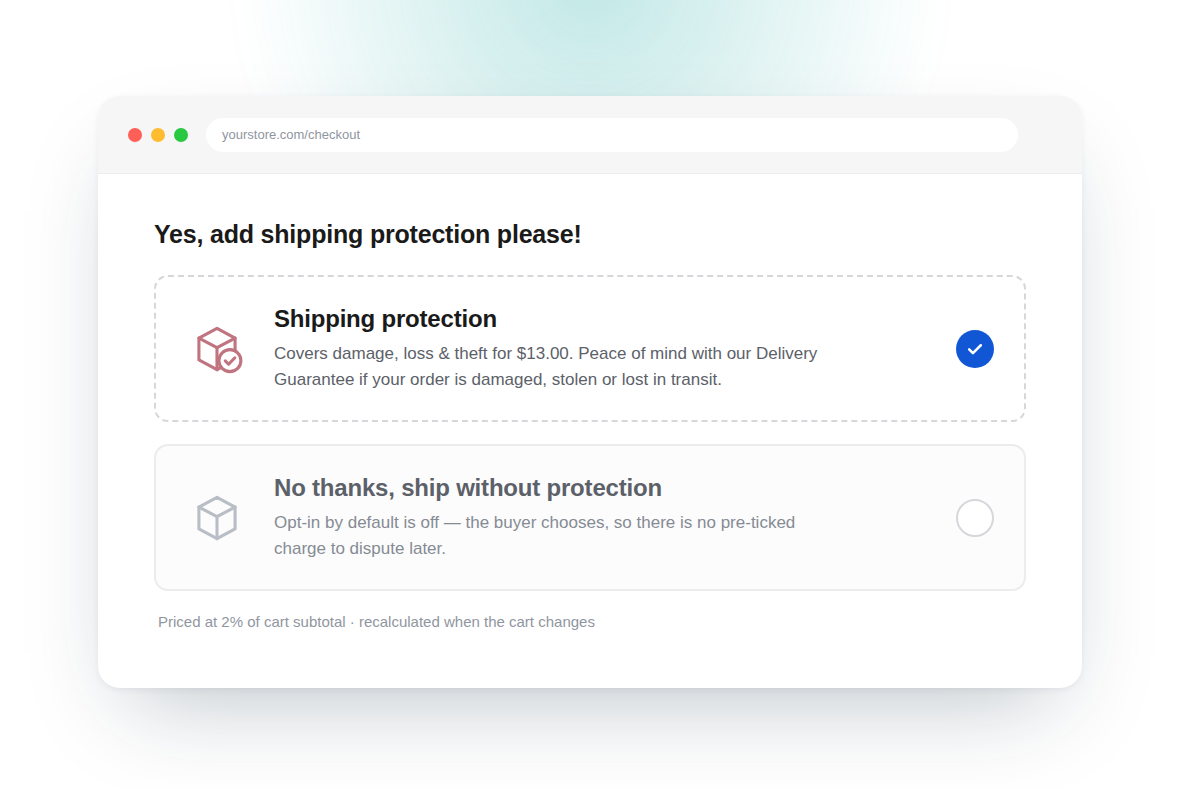
Shipping protection is the rare checkout add-on that customers genuinely want, and it pays for itself twice: once in the fee, and again in the reships you stop absorbing. We build it as an opt-in offer inside the checkout, priced as a percentage of the cart and recalculated whenever the cart changes, so the fee is never stale or wrong.
You can keep the premium or hand it to a provider. Self-insuring means you own the claims and every dollar of the revenue, which is the right call for most stores shipping domestically — and the claims flow is the part we spend the most time on, because that is what customers actually judge you by. If you would rather not carry it, we integrate Route, Corso, Navidium, Extend or Umbrella cleanly instead. The same build sells extended warranties and product protection plans too: same mechanism, different product.
Two things we will push back on. Pre-ticked protection boxes, which EU consumer law prohibits for additional charges and which generate the disputes. And calling it insurance without checking first, since selling insurance is a regulated activity in a lot of places. Your counsel decides the wording; our job is to keep it consistent across the extension, the order, the confirmation email and the claims form.
What we build
Protection offer in checkout
An opt-in shipping protection block in the order summary or beside the delivery options, built as a checkout UI extension.
Pricing that follows the cart
A percentage of subtotal or banded tiers, recalculated as the buyer changes quantities, so the fee is never stale or wrong.
Warranty and protection plans
Per-item extended warranty and product protection offers on the cart line, priced by category and price band.
Self-insured or provider-backed
Your own programme where you keep the premium, or a clean integration with Route, Corso, Navidium, Extend or Umbrella.
The claims flow behind it
Intake form, approval rules, reship or refund, and the Flow automations so support is not doing this by hand.
Reporting you can act on
Attach rate, revenue per order, claim rate and net margin, broken out by product and destination.
Blocks we ship
Drop-in checkout blocks, live on real stores — no code, no compliance headaches.
Questions, answered
Do I need Shopify Plus to add shipping protection to checkout?
To put it inside the checkout steps themselves, yes — Shopify restricts those extension targets to Plus. On other plans we place the offer in the cart and cart drawer, and on the thank-you and order status pages, which still captures a large share of the opt-ins.
How does shipping protection technically work on Shopify?
It is a product. The extension adds a hidden protection variant to the order as a cart line when the buyer opts in, and removes it when they opt out. Shopify's own extension documentation uses exactly this pattern for a warranty add-on. The interesting engineering is in pricing it against a changing cart and keeping it in sync.
Should I self-insure or use Route or Corso?
Self-insuring means you keep every dollar of the premium and own the claims. With a typical claim rate that is very good margin, and it is the right answer for most stores shipping domestically. A provider makes more sense for high-value goods, heavy international volume, or when you simply do not want the operational load. We build either, and we will say which one we think fits your numbers.
Is shipping protection the same as insurance?
Not necessarily, and the distinction matters. Selling actual insurance can require licensing depending on where you operate, which is why most merchant-run programmes are worded as shipping or package protection with a stated remedy rather than a policy. Your counsel makes that call; we build to whatever they decide and keep the wording consistent everywhere it appears.
Can the protection be ticked by default?
You can, and we would push back. Pre-ticked boxes for an extra charge are prohibited under EU consumer law, several other markets are heading the same way, and buyers who find a fee they did not choose are the ones who charge back. A clear, well-placed opt-in with a real benefit converts well without the risk.
Can we sell extended warranties the same way?
Yes — a shipping warranty and an extended product warranty run on the same machinery, just a different product and a different trigger. Warranty offers usually sit on the individual cart line, priced by category and price band, so a $2,000 item and a $40 item do not get the same plan.
What happens to the protection fee on a refund or return?
That is a policy decision with a technical tail, and it is the part most implementations skip. We define how the protection line behaves on full refunds, partial refunds and returns, wire it into your refund flow, and make sure it reports separately so your finance team is not unpicking it from product revenue.
Related services
Checkout UI Extensions
Custom checkout content, upsells and fields built as supported UI extensions on Shopify Plus.
Learn moreShopify Checkout Customization
Migrate to checkout extensibility and customize the checkout page with UI extensions, Functions and branding.
Learn moreDelivery and Shipping Customization
Control which delivery and shipping methods show at checkout, and how they are named and ordered.
Learn moreReady to build a store worth talking about?
Tell us where your store is today and where you want it to go. We reply within two working days with a clear next step.